News


Outfits with Sunglasses
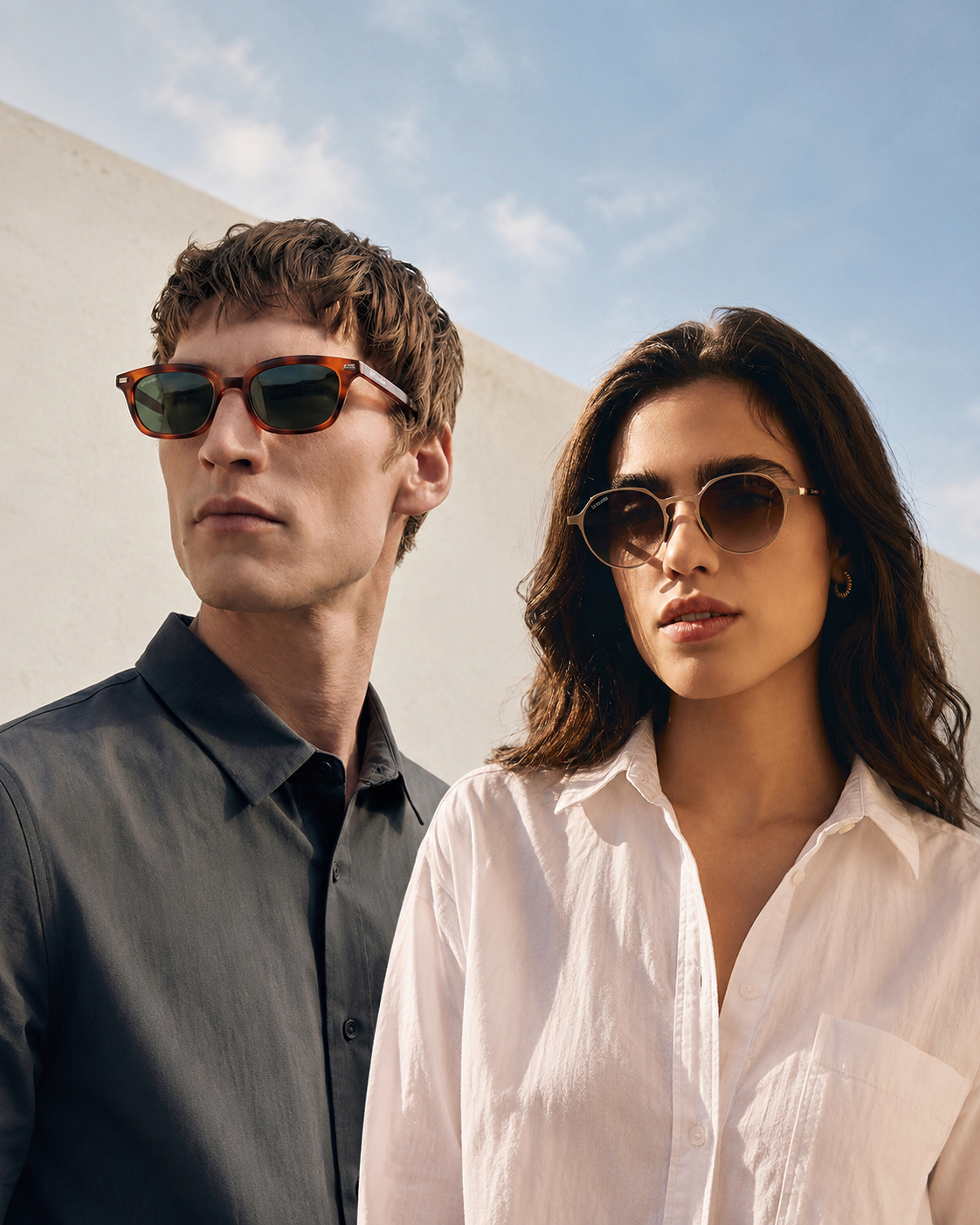
Sunglasses are that detail that completely transforms an outfit without the need to change key pieces. They are an element that goes beyond the color of the outfit or the type of clothing you wear, but one that defines style, reinforces personality, and brings visual coherence to the overall look from the very first impression. Sunglasses are no longer just a simple accessory but have become a strategic functional piece within a look. Knowing how to properly incorporate each type of eyewear, whether men’s sunglasses or women’s sunglasses, is what makes the difference between a basic outfit and one with intention. The role of sunglasses in today’s outfits Sunglasses are part of the outfit’s construction, whether to bring balance to the overall look or to add the accent that defines the entire outfit. Some aspects that directly affect the decision of which sunglasses go with which type of clothing are: The shape of the frame, not only in relation to the shape of the face, but also how it impacts the rest of the outfit. The color of the lenses, an important detail when deciding whether they should be the balancing point or the contrasting element of the outfit. The overall style of the look, the key to deciding everything lies in functionality in relation to the context and your own personality. The result is a more balanced and cohesive outfit, where each element fulfills a clear aesthetic function. Urban outfits with sunglasses Urban style, which combines comfort, functionality, and contemporary aesthetics, remains one of the most relevant this year. The keys to this aesthetic lie in the use of: Basic garments such as jeans, plain T-shirts, and sweatshirts. Neutral colors or simple combinations. Sneakers as the foundation of the outfit. Recommended sunglasses for urban style Sunglasses with straight lines or square frames work especially well in this context and for oval or round faces. The structure that reinforces the character of the outfit on more angular and square faces is provided by wraparound designs and oversized frames with rounded finishes. Dark or slightly gradient lenses fit naturally with the urban aesthetic without creating excessive contrast, resulting in a functional option that provides comfort without complications. Minimalist outfits with sunglasses Fewer elements, but ones that create emphasis without standing out too much. Minimalism continues to gain ground year after year and becomes increasingly sophisticated in the details. The most notable features of this style that transcends seasons are: A reduced color palette. Garments without prints. Clean, well-defined cuts. Recommended sunglasses for minimalist style Following the same line as a look defined by clean planes, sunglasses with simple, understated designs are the best option. Thin frames and neutral colors bring coherence, because what stands out most in this style is quality and precision. Sporty outfits with sunglasses Sporty style goes beyond functional use and blends into everyday life through outfit trends that have already earned a name of their own. The key features of the athleisure look that remain strong this season are: Leggings, joggers, or technical garments. Fitted tops or lightweight sweatshirts. Breathable materials. Recommended sunglasses for sporty style Sport or wraparound sunglasses are the most suitable option and work well with both oval faces and more defined features. By offering great coverage and reinforcing the natural active aesthetic of this type of outfit, key details such as mirrored or smoked lenses in color work especially well in this style. Elegant outfits with sunglasses Sunglasses also play a role in more polished looks, where the goal is to maintain sophistication without losing comfort. The keys to this style can be summed up as: Structured garments, such as blazers, dresses, or coordinated sets. Solid, well-combined colors. Carefully considered details that stand out without excess. Recommended sunglasses for elegant style Cat-eye frames or more refined designs add an elegant touch without breaking the harmony of the outfit. Lenses in brown, gray, or slightly gradient tones help maintain visual balance. How to match sunglasses according to the color of the outfit Color is one of the most important factors when properly incorporating sunglasses into a look. Outfits in neutral tones You can wear sunglasses with dark, mirrored, or even bolder frames, creating the contrasting point that stands out in the outfit. Outfits with bold colors Sunglasses in neutral tones help balance the outfit and prevent the aesthetic from feeling overloaded. Monochromatic looks Sunglasses are the point where you can break the uniformity, with colors and shapes that contrast with the outfit, or reinforce it by keeping the same range in classic, lightweight-looking frames. Common mistakes when creating outfits with sunglasses Forgetting the importance of context: Not all sunglasses work in every setting. A sporty model may not fit a more formal look. Too many striking elements: When the outfit already has several focal points, adding very bold sunglasses can overwhelm the overall look. Lack of consistency in style: Sunglasses should follow the same aesthetic line as the rest of the outfit, because mixing styles without a very clear intention only creates visual disorder. Why sunglasses define the outfit in 2026 Sunglasses are one of the most visible elements and have the greatest transformative power, which is why, in current trends, details carry more weight than ever. The versatility of the most current models is explained by that functional importance that sunglasses have gradually gained in recent years. Properly incorporating sunglasses into an outfit means understanding how each element interacts within the overall look. At D.Franklin, we understand that choosing the right shape, color, and style makes it possible to build more cohesive looks, current, and full of personality.
View more
How to choose sunglasses based on your face shape
There is one detail that makes the difference between sunglasses that simply “look good” and others that completely elevate your image. It is not only about trends, nor the color of the frame or the lens treatment. The key lies in the shape of your face. Making the right choices and achieving a balanced result in any style simply depends on choosing the right sunglasses for your face shape. Here we clearly explain how to choose sunglasses according to your face shape, applying practical criteria that work in everyday life. Why choosing the right shape matters Sunglasses are much more than a functional accessory, as they act as a structural element within an outfit. They can soften features, add character, or balance proportions. Whether they are men’s sunglasses or women’s sunglasses, when the shape does not fit, the result is usually disproportionate. The basic rule is to contrast shapes, avoiding repeating the same geometry of the face in the shape of the frame. Face types and which sunglasses suit them best When sunglasses fit within a clearly identified visual structure, the effect of harmony is immediate. Sunglasses for oval faces An oval face is characterized by being balanced, with soft and slightly elongated proportions. For oval-shaped faces, what works best is: Square sunglasses, especially if they are a good size. Rectangular sunglasses, especially with oversize frames. Sunglasses with wraparound frames. This type of face suits practically any style, but more angular shapes help add structure, while excessively small sunglasses break the proportion Sunglasses for round faces It is identified by full cheeks and soft lines, with little angular definition and a rounded chin. For round-shaped faces, what works best is: Square sunglasses, with well-defined angles. Rectangular sunglasses, with wraparound frames Octagonal sunglasses, especially in oversize models. Straight lines help visually elongate the face and add definition, while avoiding round shapes that accentuate the natural lines of the face. Sunglasses for square faces It stands out for a defined jawline and strong proportions, with the forehead and cheekbones having a similar width, creating a symmetrical structure. For square-shaped faces, what works best is: Round sunglasses, especially those with wide frames. Oval sunglasses, even in oversize and wraparound styles. Sunglasses with thin frames or rimless designs. Curved shapes soften the features and balance the hardness of the jawline, so it is important to avoid square frames, which tend to intensify the feeling of rigidity. Sunglasses for long faces It is a face that is longer than it is wide, with predominant vertical lines but with similar proportions that create a refined appearance. For long-shaped faces, what works best is: Oversize sunglasses, with soft contours. Wraparound sunglasses, with large and wide shapes. Sunglasses with wide frames. The goal is to visually reduce the length of the face, especially by avoiding narrow and small frames. Heart-shaped face It is characterized by a broad forehead, high cheekbones, and a narrower chin. For heart-shaped faces, what works best is: Aviator sunglasses, with a thin frame and rounded inverted teardrop shape. Rounded sunglasses, with soft angles. Sunglasses with lightweight or barely visible frames. These options balance the upper part of the face, while it is important to avoid frames that are very large at the top. Key factors beyond shape Choosing sunglasses according to your face shape is not limited only to the silhouette; there are also other elements that directly influence the final result. Frame size The size should be aligned with the proportions of the face, because a frame that is too large can dominate the face, while one that is too small loses impact. A simple practical rule is that small faces should wear compact sunglasses, while larger faces look better with wider styles. Frame color Color affects both style and harmony with skin tone, which is why brown, gold, and tortoiseshell frames work best for warm skin tones, while black, gray, and silver frames are the best choice for cool-toned faces. Lens type Although the focus may be aesthetic, functionality matters more and more when choosing sunglasses, which is why it is important to take usage into account: Polarized lenses: reduce glare and improve vision. Gradient lenses: provide a more sophisticated touch. Mirrored lenses: add personality and character. How to adapt sunglasses to your personal style Once you have identified the most suitable shape, color, and lens type for you, it is time to consider how to enhance your personal style. Minimalist style Sunglasses with thin frames Frames in neutral colors Clean and sophisticated designs Urban style Sporty sunglasses Wraparound frames Mirrored lenses Classic style Aviator sunglasses Square sunglasses Frames in dark or metallic tones Creative style Cat-eye sunglasses Frames in geometric shapes Bold colors in frames and lenses Choosing sunglasses according to face shape is not about following rigid rules, but rather a strategic process that combines proportion, contrast, and style to understand what works and why. When these criteria are applied, sunglasses stop being just another accessory and become a key piece within your personal image. At D.Franklin, we offer a wide variety of sunglasses with frames and lenses that ensure a coherent, balanced, and adaptable result for any future trend.
View more
2026 Sunglasses Trends
Lighter materials, unexpected colors, and designs that blend past fashions with future trends; something is changing in sunglasses, and it’s not just this. The sunglasses trends of 2026 are already setting the pace on runways, social media, and streets around the world.
View more
What is TR90 in sunglasses?
Design may vary, color changes, and shape marks the style, but the frame material determines a large part of the wearing experience. In recent years, the technical term TR90 has begun to appear consistently in product sheets and specialized descriptions. Behind this material is a clear evolution in the way glasses designed for daily use, movement, and durability are manufactured. Understanding what the use of TR90 means in glasses allows for understanding why this material has become a reference within the optical sector and functional fashion. What is TR90 applied to glasses TR90 is a type of advanced thermoplastic developed from a combination of high-resistance polymers. Its main characteristic is the ability to adapt to shape without losing its original structure, which is why it is used in the manufacture of frames for different types of sunglasses. This material stands out for its lightness, flexibility, and resistance to impacts and deformations. As it is not a conventional plastic, its composition offers a wide creative range to obtain comfortable, durable frames prepared for intensive use. Why TR90 is used in eyeglass frames Real lightness for daily use Due to the lightness of this material, frames made with TR90 reduce pressure on the nose and ears, which is especially relevant during prolonged use. Controlled flexibility TR90 has elastic memory, which means it can bend or deform temporarily and return to its original state without breaking or losing its fit. High impact resistance TR90 frames withstand shocks, twists, and adjustments better than any other material, also increasing their lifespan. Differences between TR90 and other common materials TR90 vs. Acetate Acetate is a material widely used in glasses for its aesthetic finish and variety of colors; however, it is usually heavier and less flexible than TR90. TR90 vs. conventional plastics Compared to standard plastics, TR90 offers much higher durability, without becoming brittle over time or losing properties with moderate temperature changes. TR90 vs. metal Metal frames stand out for their rigidity and aesthetics, but they are often heavier and less tolerant of impacts than those made of TR90, a more flexible and lighter alternative. Key advantages of glasses made of TR90 Reduced weight for greater comfort Flexibility with shape recovery High resistance to shocks and twists Good performance against moisture and sweat Stable fit for longer These advantages explain why TR90 glasses are used in urban models as well as in sports or sun glasses. TR90 and comfort as a determining factor TR90 allows for designing frames with a more uniform fit, avoiding specific pressure points. Furthermore, its soft touch and adaptability make the glasses integrate better into daily use, even for several hours at a time. Comfort is especially relevant for active people who use glasses continuously. TR90 performance in heat and cold TR90 maintains its properties across a wide range of temperatures, without deforming or becoming fragile with temperature changes. This thermal stability is a clear advantage over other materials that may lose rigidity or flexibility depending on the environment. Maintenance and durability of TR90 Glasses made of TR90 do not require special care; regular cleaning and normal use are enough to keep the frame in good condition. The material does not rust, does not crack easily, and retains its appearance for a long time, even with intensive use. Why TR90 has become a standard The rise of TR90 in the optical sector responds to the need to offer comfortable, resistant frames adapted to today's pace of life. TR90 glasses represent a technical evolution that prioritizes the user experience without sacrificing design or functionality. Its combination of lightness, flexibility, and durability explains why this material has established itself as a reference in both sunglasses and prescription glasses. Knowing the material is the first step to understanding why certain frames offer a different feeling from the first use. At D.Franklin, all models are manufactured in TR90, committing to a design where comfort and aesthetics combine perfectly to keep up with the modern pace of life.
View more
Combine sunglasses and a cap
Combining sunglasses and a cap seems like a simple decision, but the result can either elevate a look or completely break its coherence. The key to finding balance lies in how they integrate with each other and with the rest of the outfit. In recent years, this combination has become part of urban style, streetwear, and everyday looks where image carries as much weight as comfort. Understanding the basic rules for achieving the perfect balance allows the ensemble to work naturally, without appearing forced. At D.Franklin, we explain the keys to combining sunglasses and a cap with discernment, considering shapes, colors, proportions, and context. The role of sunglasses and the cap within the look Both accessories fulfill a clear function in personal care, but they also have significant visual weight. Sunglasses act directly on the face, while the cap defines the upper part of the silhouette. When combined, neither element should compete for prominence, nor convey opposing aesthetic messages. Coherence and balance between both accessories are what make the difference in the final result and complete the look. How to combine sunglasses and a cap according to style Urban and casual style In urban looks, the key is simplicity, and clean lines in the cap's design are a definition of style. In this approach, sunglasses with balanced frames work better than excessively flashy designs. Neutral colors, recognizable shapes, and matte materials help integrate the set into daily life effortlessly. Well-defined sporty style When the look has a sporty base, both the cap and the sunglasses must share that language. Technical or sports-inspired caps fit better with wrap-around sunglasses or aerodynamic lines. The important thing here is to avoid mixing a sporty style cap with elegant aesthetic sunglasses, as the contrast breaks the coherence of the ensemble. Minimalist style Minimalism always bets on fewer elements, but these must be better selected, combining shape and color rather than visual impact. Plain caps, without excessive logos, combine with soberly designed sunglasses to create a clean and modern result. The importance of shapes when combining Proportion between cap and glasses The key is to prevent one accessory from eclipsing the other, helping to maintain constant visual harmony in the upper area. Voluminous caps combine better with medium or large frame sunglasses. Conversely, a low-profile cap works better with more discreet glasses. Face shape and set selection Angular faces benefit from more rounded sunglasses and caps with soft lines. Rounder faces are usually balanced with straight-lined glasses and structured caps. Colors to get it right without overloading the look Neutral tones as a safe base Black, white, gray, beige, or navy blue are colors that make combining sunglasses and a cap easy and error-free, acting as a base that offers greater freedom for the rest of the outfit. Controlled contrast Contrast only works when it is well-measured. A light-colored cap with dark glasses, or vice versa, provides dynamism without breaking the general aesthetic. As a general rule, it is recommended that only one of the two accessories carries the main color. Avoid color saturation Using very bright colors on both accessories at the same time usually generates visual noise. If the glasses stand out for their color or design, the cap should be more discreet, and vice versa. Materials and finishes that work best together Materials also communicate and, in some contexts, are an important part of the style perceived as part of personal attitude. Cotton, canvas, or technical fabric caps combine better with acetate sunglasses or matte finishes. While excessive shine on both elements tends to clutter the ensemble, in urban contexts, matte and semi-matte finishes provide a more modern feel. Common mistakes when combining sunglasses and a cap Mixing opposite styles without a clear aesthetic intention Using both accessories with excessive logos or details Ignoring the proportion between face, cap, and frame Opting for overly saturated colors on both elements Identifying these errors helps to understand why some combinations do not work, even when each accessory is correct on its own. However, the context is decisive when making decisions regarding accessory combinations. Combining sunglasses and a cap for an outdoor plan, an urban environment, or a daily commute requires adjusting the formality level of the ensemble to avoid visual mismatches. Coherence as the base of any combination Combining sunglasses and a cap well does not depend on following specific trends, but on understanding how both accessories dialogue with each other. Shape, color, proportion, and context are the variables that define the final result. When these keys are applied with discernment, the combination stops being a functional resource and becomes a natural extension of personal style. At D.Franklin, you will find the components and accessories needed to achieve the perfect everyday look regardless of the environment.
View more
What is a polarized pair of sunglasses?
Polarized sunglasses are not a trend or a recent marketing gimmick; they respond to the need to avoid reflections and glare. Although at first glance they may look the same as other sunglasses, when you use them outdoors the visual experience changes noticeably. Same shape, same lens color, and an apparently similar design, but polarization technology is neither accidental nor subjective. Understanding how polarized sunglasses work makes it possible to appreciate why they are used in certain environments and activities. Understanding what polarized sunglasses are means knowing how light behaves, how it affects the human eye, and what this type of lens provides compared to a conventional sun lens. What polarized sunglasses are Polarized sunglasses are those that incorporate lenses with a special filter designed to block reflected light from horizontal surfaces. This type of light is the main cause of glare that occurs in environments such as roads, water, snow, or sand. Polarization selectively filters the light that reaches the eye, allowing a sharper perception, with higher contrast and less visual fatigue. Unlike a standard sunglass lens, which reduces the total amount of light, the polarized lens acts on the direction of that light. How polarization works in a lens Reflected light and glare When sunlight hits a flat surface, such as wet asphalt or the sea, it is reflected horizontally. That intense reflection causes glare, loss of contrast, and an uncomfortable visual sensation. This phenomenon does not depend on the intensity of the sun, but on how light reflects off certain surfaces. The polarizing filter Polarized lenses incorporate a chemical filter that acts like a microscopic grid. This filter blocks horizontally reflected light and allows vertical light to pass through, which is what provides useful visual information. The result is a clearer image, with more defined colors and without annoying reflections. Differences between polarized sunglasses and conventional sunglasses True glare reduction The main difference between polarized sunglasses and conventional ones lies in their ability to eliminate reflections. Conventional sunglasses darken, but they do not eliminate glare, whereas polarization acts directly on the cause of the problem. Improved contrast and sharpness Polarized sunglasses make it possible to distinguish details better, especially in very bright environments. Colors are perceived as more defined and transitions between shade and light are smoother, which is especially relevant for outdoor activities. Less visual fatigue By reducing reflections and the eye’s adaptation effort, polarized lenses reduce visual fatigue during prolonged exposure to the sun. What situations polarized sunglasses are designed for Driving On the road, polarized sunglasses improve visibility and provide a more stable perception of the surroundings, avoiding reflections from the asphalt, the dashboard, or other vehicles. Water activities On the water, polarization allows you to see through the surface more clearly, reducing sparkle and improving the perception of depth and movement. Use in high-brightness environments Snow, sand, or light-colored surfaces generate a large amount of reflected light. Polarized sunglasses help maintain comfortable, controlled vision in these scenarios. Real advantages of polarized sunglasses Effective elimination of reflections Greater visual clarity Improved contrast Reduced eye fatigue More stable outdoor vision These advantages do not depend on lens color or frame design, but exclusively on the presence of the polarizing filter. Possible limitations of polarized sunglasses Understanding what polarized sunglasses are also means knowing their limits, for example, on some digital screens they can make viewing difficult from certain angles. This effect is due to the interaction between the lens’s polarizing filter and the screen’s filter, and it is not a product defect. How to identify polarized sunglasses There are simple methods to check whether a lens is truly polarized. One of the most common is to look at a digital screen and slightly rotate the glasses; if the image darkens or changes noticeably, the lens is polarized. This behavior confirms the presence of the filter and its ability to block certain directions of light. Polarization and UV protection are not the same A key point is to distinguish polarization from ultraviolet protection, as both features serve different, complementary functions. Polarized sunglasses may not protect against UV rays if they do not include the appropriate treatment, and sunglasses with UV protection may not be polarized. Understand the usefulness before choosing Knowing what polarized sunglasses are helps you understand why this type of lens is used in specific contexts and what it offers compared to a conventional sun lens. It is a technical solution designed to optimize vision in high-brightness conditions. Polarization responds to the need to see better when light reflects, avoiding discomfort and improving perception of the surroundings. At D.Franklin you’ll find polarized sunglasses in collections that, in addition to caring for your vision, offer an aesthetic designed to elevate your look.
View more
How is the Shaft of a Boot Measured?
Understanding how a boot shaft is measured makes it easier to interpret product specs correctly, compare different styles, and avoid common mistakes when shopping online. If there’s one detail that makes the difference between a comfortable boot and one that ends up forgotten in the back of the closet, it’s the perfect shaft fit. The shaft measurement has nothing to do with shoe size, nor with the material, or even the design. It’s a specific dimension that determines both how the boot fits and how it looks. Although it’s often overlooked, the shaft size isn’t a decorative detail—it’s a key technical reference that affects height, fit around the leg, and the overall proportions. In this guide, we explain in practical terms what the boot shaft is, how to measure it correctly, and how to interpret that measurement depending on the type of boot. What is a boot shaft and why it matters The shaft is the part of the boot that covers the ankle and the leg. Its height determines how far up the footwear reaches and influences both comfort and the visual effect on your silhouette. A well-chosen shaft helps elongate the leg, provide support, and adapt better to the intended use. Likewise, a poor choice—such as a shaft that’s too high or too low for the right context—can feel uncomfortable and impractical. That’s why the shaft measurement is especially relevant for knee-high boots, mid-calf boots, and ankle boots, although it’s also considered in other designs. How to measure a boot shaft correctly Starting point for the measurement The shaft is always measured from the inside of the boot, using the base of the heel as the starting point—right where the foot rests on the ground—without including the height of the heel or the sole. This detail matters, because many people assume the measurement includes the heel, which causes confusion when comparing styles. End point for the measurement The end point is the top edge of the boot at the back, measuring in a straight line along the vertical axis of the boot, without tilting the tape measure. The result is usually expressed in centimeters and represents the true shaft height. The difference between shaft height and shaft circumference When checking product details, it’s common to find two different measurements related to the shaft: Shaft height, which indicates how high the boot reaches on the leg. Shaft circumference, which measures the perimeter at the top—meaning the width of the boot around the calf or ankle area. Height describes the vertical length, while circumference describes the fit around the leg. They complement each other but are never interchangeable, and they are not directly linked to one another. How to interpret shaft measurements by boot type Shaft measurement in ankle boots Ankle boots have a short shaft that typically measures between 8 and 15 centimeters, depending on the design, covering the ankle and sometimes slightly above it. With this type of footwear, shaft height affects ankle mobility and how the boot integrates with both trousers and skirts. Mid-calf boots Mid-calf boots usually fall between 18 and 25 centimeters, covering part of the calf and offering a balance between protection and a lighter visual look. This height is common in urban styles and models designed for everyday wear. Knee-high boots Tall boots have a shaft height over 30 centimeters and can reach the knee—or even above it. In these cases, shaft measurement becomes especially important because it determines comfort when walking and sitting, and a difference of just a few centimeters can completely change how the boot feels. Factors that influence how the shaft height looks Even though the measurement is objective, several elements affect how tall the shaft appears once the boot is on: Height of the wearer: On shorter people, the same shaft height can look taller. Vamp design: Boots with a more closed vamp can give the impression of greater height. Sole type: Chunky soles visually elevate the boot, even if they don’t change the true shaft measurement. Top edge shape: Straight or asymmetrical cuts influence the visual effect on the leg. These factors help you interpret the technical specs more accurately when shopping online. Common mistakes when measuring or interpreting the shaft One of the most common mistakes is measuring the shaft from the outside of the boot. This can distort the true reference and make it harder to compare different styles. Another frequent mistake is assuming all boots within the same category have the same shaft height. Even within a single type, variations can be significant. It’s also common not to connect the shaft measurement to the intended use. A boot designed for long hours of walking needs a different height and fit than a more purely aesthetic style. Why shaft measurement is key when buying online In a physical store, you can feel the shaft height and fit when trying the boot on, but online, the measurement is the only objective reference. Knowing how a boot shaft is measured lets you read product information correctly, compare models with confidence, and reduce returns due to fit issues or discomfort. In addition, knowing the exact shaft measurements—both height and circumference—helps you anticipate how the boot will look with different outfits, which is especially relevant for tall and mid-calf boots. A boot’s shaft is a technical measurement that directly affects comfort, fit, and overall style. That’s why it’s so important to understand how it’s measured—from where to where—and to interpret how each boot type can work with your everyday personal style. Once you master this concept, product specs stop being confusing and become a genuinely useful guide. Knowing how a boot shaft is measured is, ultimately, a practical way to choose better and shop with more confidence.
View more
Best-Selling Women’s Shoes
The best-selling women’s shoes are what turn a trend into the kind of fashion that defines your current wardrobe. There are patterns that repeat season after season; some styles appear, others disappear, but only a few manage to stay among the favorites year after year. These are designs that respond to changes in lifestyle, to new priorities, and to a more practical way of understanding fashion. Women’s footwear has evolved toward options that balance aesthetics, comfort, and versatility. Real-life wear comes first, balancing the need to walk more, style the same pair with different outfits, and prioritize materials that feel good for everyday use. In this article, we explore which styles dominate the current market and why they’ve become wardrobe essentials for any woman. The best-selling women’s shoes aren’t a passing trend; they’re a choice that fits the way we live and dress today. Why some shoes become best-sellers Before we start talking about specific styles, it’s worth understanding what factors make a shoe stand out from the rest. Comfort is the first point, since ergonomic designs, flexible soles, and materials that adapt to the foot have been climbing into the top sales positions year after year. Versatility is the second key aspect, because a shoe that works for both a casual look and a more polished outfit multiplies its chances of being worn. The decisive factor, however, is still the style itself. Best-selling designs tend to have a recognizable aesthetic each season. Even so, there are women’s shoe styles that age well, and that stay relevant beyond a single season. Best-selling women’s sneakers in recent years Without a doubt, they bring together the key factors of comfort and design, and they’ve also gained a strong place in terms of versatility, pairing with more and more outfits. White and neutral sneakers White sneakers top the sales rankings, thanks to their ability to go with everything—from jeans to flowy dresses. It’s clean designs, with minimal decorative elements, that work equally well in urban settings and more laid-back looks. Sneakers in soft colors Beige, cream, dusty pink, or light green tones have established themselves as alternatives to white, adding something different without losing easy styling. These types of sneakers are often among best-sellers for their balance of style and subtlety. Sneakers with a slightly elevated sole Soles with a bit more volume add extra comfort and elongate the silhouette, while staying functional for everyday wear. Boots that reinvent themselves every season Boots are a classic that keeps evolving, and each season brings top sellers that add a stylish touch through different designs and materials. Chelsea boots Chelsea boots are one of the best-selling women’s styles, with a simple design, elastic side panels, and a clean silhouette that makes them easy to pair with trousers, skirts, or dresses. Flat boots with an urban feel Flat designs, with durable soles and robust finishes, respond to the need to walk more without giving up style. They’re common in urban environments and stand out for their durability. Boots with an inner lining Styles with a warm interior remain among best-sellers during colder months, as they offer thermal protection without resorting to overly bulky designs. Must-have sandals for warm weather When hot days arrive, sandals quickly climb into the best-selling shoe ranks, with an wide variety of styles that surprise every year and expand across different shapes, colors, materials, and aesthetics. Flat sandals Flat sandals stand out for their practicality, but also because their designs can be as simple as they are sophisticated, with secure straps and materials that feel good against the skin—available in a wide range of comfortable, versatile options. Sandals with a moderate platform Soft platforms let you gain height without sacrificing stability, making this type of sandal one of the best-selling shoe styles each season, thanks to lasting comfort and a balanced look. Best-performing materials and finishes The best-selling women’s shoes often share a few common elements: Durable materials that stand up to frequent wear and perform season after season. Easy-to-maintain finishes, that don’t require big investments or special care. Timeless designs that don’t depend on a specific trend and are easy to style with different looks. Wearable, versatile colors that work across different styles and seasons. These factors directly influence decision-making, especially in a context where mindful purchasing and sustainability in manufacturing and post-consumer processes are increasingly prioritized. How to read trends without chasing passing fads Knowing the best-selling women’s shoes can serve as a reference to identify what types of footwear work best day to day—and why. The key is adapting trends to personal needs, the climate, your pace of life, and your own style. Taking this approach makes it easier to find balanced collections, designed to last beyond a single season and accompany different moments of the day. The success of the best-selling women’s shoes lies in the perfect combination of real comfort, functional design, and timeless aesthetics. Versatile sneakers, practical boots, and flat shoes alongside comfortable sandals dominate the market because they reflect how we live and dress today. Understanding these keys helps you make smarter, more logical choices to build a more coherent wardrobe, where each pair of shoes serves a real purpose and adapts to different everyday situations. At D.Franklin, we offer a wide variety of women’s footwear, always focusing on comfort, urban style, and functionality, using durable, high-quality materials.
View more